By Sean Dilweg, Former Wisconsin Insurance Commissioner
The insurance story attracting attention this week is understandably centered on some very large numbers.
Delaware Life Insurance Company, owned through Mark Walter’s Group 1001 and TWG Global organization, restated its financial statements and reclassified a significant portion of its investment portfolio as affiliated or related-party assets. Reuters reports that affiliated investments went from less than 5% of invested assets to approximately 42% at year-end 2025. TWG has now agreed to exchange as much as $6.5 billion of those investments for assets classified as unaffiliated, subject to regulatory approval.
TWG says there was no fraud and says it is cooperating with federal and state regulators. Federal prosecutors and the SEC are examining the transactions, but investigations are not findings of wrongdoing.
Those facts are important.
But from an insurance regulatory perspective, I believe the larger question is more interesting:
When is an investment that is legally separate from an insurer still economically affiliated with the people who control the insurer?
That question is becoming increasingly important as insurance, private credit and alternative asset management converge.
An insurance company exists first to fulfill obligations to policyholders. Its investment portfolio therefore has to provide an appropriate combination of safety, liquidity, diversification and return.
A corporate parent or investment manager may have additional objectives.
It may want financing for another business. It may want to originate private-credit assets. It may want to support an acquisition. It may want an insurer within the corporate group to purchase investments generated elsewhere in the organization.
Those interests can coexist. But regulators want to know when they do.
That is why affiliate transactions receive additional disclosure and regulatory scrutiny. The concern is not simply whether an asset ultimately performs. The concern is whether the insurer made the investment on terms that would have existed if the parties were genuinely independent.
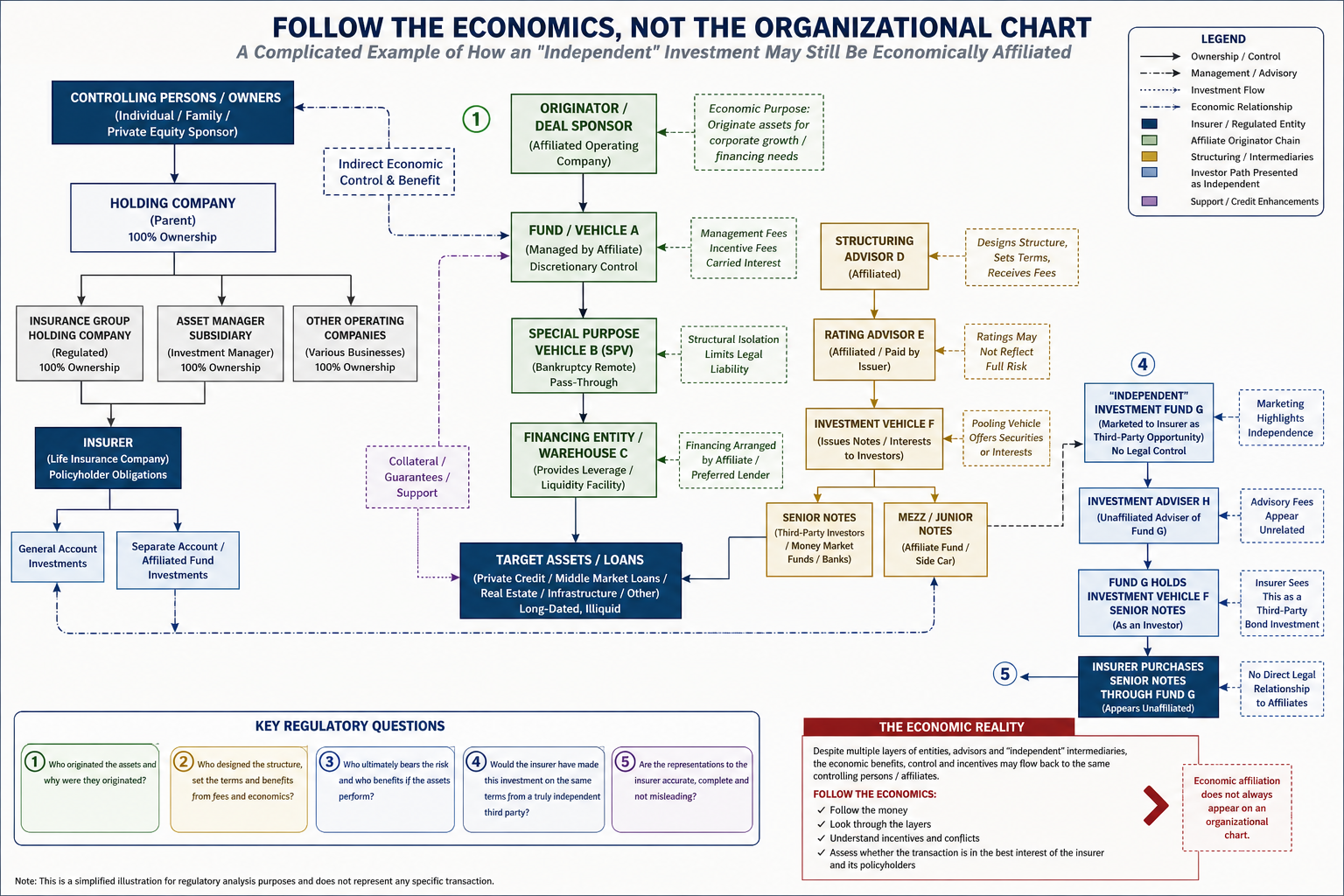
Consider a simplified example:
· An insurer lends money directly to another company owned by its parent
· That is easy. Everyone recognizes the transaction as affiliated.
· Now insert an investment fund between them.
· Then add a special-purpose vehicle.
· Then have an ostensibly independent lender originate the loan.
· Then have another entity purchase or guarantee a portion of it.
· At some point, the legal relationships may suggest that the insurer purchased an investment from an independent third party.
· But economically, the insurer’s capital may still be financing businesses connected to the same controlling interests.
That is where regulators have to look beyond organizational charts.
The question becomes:
Who ultimately benefits if the investment succeeds, and who bears the loss if it fails?
According to Reuters, the federal scrutiny involving Walter’s companies concerns whether private-credit investments linked through intermediary businesses should have been reported as affiliated investments. Delaware Life’s internal review led to substantial reclassification of those assets.
That distinction matters enormously.
Affiliated.
Unaffiliated.
Related party.
Independent.
But these classifications have real regulatory consequences.
They affect disclosure. They influence investment limits. They influence how regulators assess concentration and conflicts of interest. They can affect capital analysis. And perhaps most importantly, they affect how a financial analyst understands the insurer’s actual exposure to its broader corporate organization.
Imagine an insurer that appears to have a diversified $20 billion private-credit portfolio.
If $10 billion of those investments ultimately depend upon companies connected economically to the insurer’s controlling owner, the regulator is looking at a very different risk profile.
The credit risk may not have changed. But the concentration risk and governance risk have. That is exactly why the distinction matters.
The company says it will exchange up to $6.5 billion of Delaware Life’s affiliated investments for an equivalent amount of non-affiliated assets. TWG would take the affiliate-linked investments, while the insurer would receive independent assets.
That could materially improve the insurer’s regulatory position.
But a regulator will understandably examine more than the dollar amount.
An exchange of $6.5 billion for $6.5 billion does not necessarily mean the insurer receives identical economic value.
Regulators will want to understand the credit quality, duration, liquidity, valuation and expected cash flows of the replacement assets.
They will also want to know who valued both sides of the transaction.
And because the transaction itself involves affiliated parties, regulators will need confidence that the insurance company, not simply the broader organization, benefits from the exchange.
That is traditional insurance regulation applied to a very modern financial structure.
Life insurers have always invested premiums to generate returns that help fund long-duration obligations. What has changed is the increasing integration between insurers and sophisticated alternative asset managers.
Those managers can originate private loans that may provide attractive yields relative to publicly traded bonds. That can be beneficial to insurers. Private credit itself is not the problem.
The regulatory challenge arises when the same organization, or economically connected parties, can influence multiple parts of the transaction:
originating the asset, structuring it, rating it, managing it and ultimately placing it onto an insurer’s balance sheet.
At that point, traditional regulatory categories can struggle to capture the entire economic relationship. And that is precisely when regulators should become more interested, not less.
Eventually it returns to economics.
Who controls the transaction?
Who receives the financing?
Who determines the valuation?
Who receives management or origination fees?
Who bears the downside?
And would the insurer have purchased the same investment, on the same terms, from a truly independent party?
Those questions can reveal more about an investment than the number of corporate entities separating the borrower from the insurer.
The lesson from the Delaware Life situation should therefore extend well beyond TWG.
As insurance companies become increasingly integrated with private-credit platforms, asset managers and complex holding-company structures, regulators will need to distinguish among three different concepts:
1) Legally affiliated.
2) Economically affiliated.
3) Actually independent.
Those categories will not always produce the same answer.
For all the complexity surrounding private credit, special-purpose vehicles and sophisticated investment structures, the underlying regulatory principle is not new.
Insurance regulators have always had a fundamental responsibility to protect the insurance company from transactions that primarily benefit someone else in the corporate family.
Modern financial engineering makes identifying those transactions more difficult. It does not make the principle obsolete.
The most effective regulators therefore will not stop their analysis when a transaction satisfies a technical definition of independence. They will continue asking the question regulators have asked for generations:
Is this transaction genuinely in the best interest of the insurance company and its policyholders?
If answering that question requires looking through several layers of legal entities, regulators should look through them.
Because when billions of dollars of policyholder assets are involved, economic substance should matter at least as much as corporate form.