By Sean Dilweg, Former Wisconsin Insurance Commissioner
For several years, insurance regulators have debated private credit largely in the language of capital charges, ratings, valuation and transparency. South Carolina has now moved that debate into a much more consequential arena: rehabilitation.
On September 16, the South Carolina Department of Insurance sought to place Atlantic Coast Life Insurance Company and Southern Atlantic Re into court-supervised rehabilitation. Insurance Director Michael Wise alleges that the companies are in a financially hazardous condition and points to concerns involving private credit, affiliated investments and exposure to failed investment firm 777 Partners. Atlantic Coast and its affiliates strongly dispute those allegations and have sued Wise, arguing that the companies remain financially sound and that the department acted improperly.
Then, on September 22, AM Best downgraded Atlantic Coast Life and sister company Sentinel Security Life from B to C+, or “Marginal,” while keeping the ratings under review with negative implications.
That sequence matters. This is no longer simply an argument over whether insurers should invest more heavily in private assets. It is becoming a real-world test of what happens when asset quality, valuation, liquidity, ratings and regulatory confidence begin to reinforce one another.
I have seen a version of this problem from the regulator’s side. As Wisconsin Insurance Commissioner during the financial crisis, I served as receiver in the Ambac matter, where investment deterioration and complex structured assets forced regulators to confront a fundamental question: at what point does an investment problem become a policyholder-protection problem?
That is ultimately the question South Carolina is facing now.
Private Credit Is Not the Problem by Itself
Private credit is not inherently inappropriate for a life insurer. Insurers have long held less-liquid assets because their liabilities are often long-duration and reasonably predictable. A fixed annuity liability extending years into the future does not require every supporting investment to trade every day.
The real questions are more basic: How much private credit does the insurer own? How concentrated is it? How is it valued? How liquid is it if policyholder behavior changes? Who originated the assets? Are the investment managers or counterparties affiliated? How much leverage exists beneath the security? And how much confidence should regulators place in the rating or valuation assigned to it?
According to the South Carolina regulator’s petition, Atlantic Coast Life had substantial exposure to below-investment-grade private credit and unrated collateral loans. The department also alleges concerns involving valuations and affiliate classifications. A-CAP disputes those allegations.
But the disagreement itself demonstrates the problem. An insurer can appear adequately capitalized until regulators begin questioning the assets supporting that capital.
Valuation Comes Before Capital
Insurance regulation places enormous emphasis on capital ratios. But those ratios are only as reliable as the asset values beneath them.
A publicly traded bond gives the regulator a market price every day. A private loan may depend instead on a model, appraisal, internal valuation process or third-party assessment.
That does not make the valuation wrong. It does make the governance around the valuation more important.
During periods of stress, a private asset can continue carrying a relatively stable reported value even while borrower performance, collateral quality or market conditions are deteriorating. The economic loss may exist before it becomes fully visible on the statutory balance sheet.
Once a regulator believes those assets are materially overstated, the issue quickly moves beyond investment management. It can affect surplus, risk-based capital and the regulator’s assessment of whether policyholders remain protected.
Credit Risk Is Not Liquidity Risk
Ratings are important, but they answer only part of the question.
A rating provides an opinion about creditworthiness. It does not necessarily tell the regulator whether an asset can be sold quickly, whether its carrying value will hold during stress or whether a concentrated position can be converted into cash without substantial loss.
That distinction is particularly important for life insurers.
An asset may ultimately pay in full and still create a serious liquidity problem if policyholders suddenly demand their money back. If annuity surrenders increase sharply, an insurer may be forced to sell assets at precisely the wrong time.
That is why a life insurer can have an investment portfolio that looks acceptable from a long-term credit perspective and still encounter short-term financial stress.
Credit risk and liquidity risk are not the same thing.
The Feedback Loop Matters
Policyholder behavior can make the situation deteriorate surprisingly quickly.
Most life and annuity liabilities are relatively predictable. But policyholders can surrender contracts, move money and respond to information about an insurer’s financial condition.
That creates a potentially dangerous feedback loop.
Regulatory action can create concern. A rating downgrade can intensify it. Increased surrenders can produce liquidity pressure. Liquidity pressure can force asset sales. And forced sales can reveal valuation differences that were much easier to ignore when the insurer was operating normally.
AM Best’s downgrade therefore matters for more than signaling credit quality. It becomes part of the insurer’s operating environment.
This is also why regulators sometimes intervene before an insurer is conventionally insolvent.
Rehabilitation Is About Acting Before Liquidation
Rehabilitation is frequently misunderstood as a declaration that an insurer has already failed. It is not necessarily that.
The purpose is generally to give the regulator and the court an opportunity to stabilize the company, preserve assets, protect policyholders and determine whether the insurer can be restored to a sound condition.
The difficult judgment is deciding when to act.
Move too late and policyholders may suffer larger losses. Move too early and the intervention itself can damage a company that might otherwise have remained viable.
I saw that tension firsthand during the financial crisis. In a receivership situation, the regulator is not simply looking backward and determining whether prior investment decisions were prudent. The regulator has to look forward and determine whether the company can continue meeting its obligations under a range of increasingly adverse assumptions.
That is a very different question.
South Carolina Director Michael Wise argues that intervention is necessary. The companies argue that the regulator has overstated their problems and that capital and restructuring initiatives can address them.
A court will now have to decide where that line should be drawn.
Follow the Affiliates
Affiliate relationships make the analysis considerably harder.
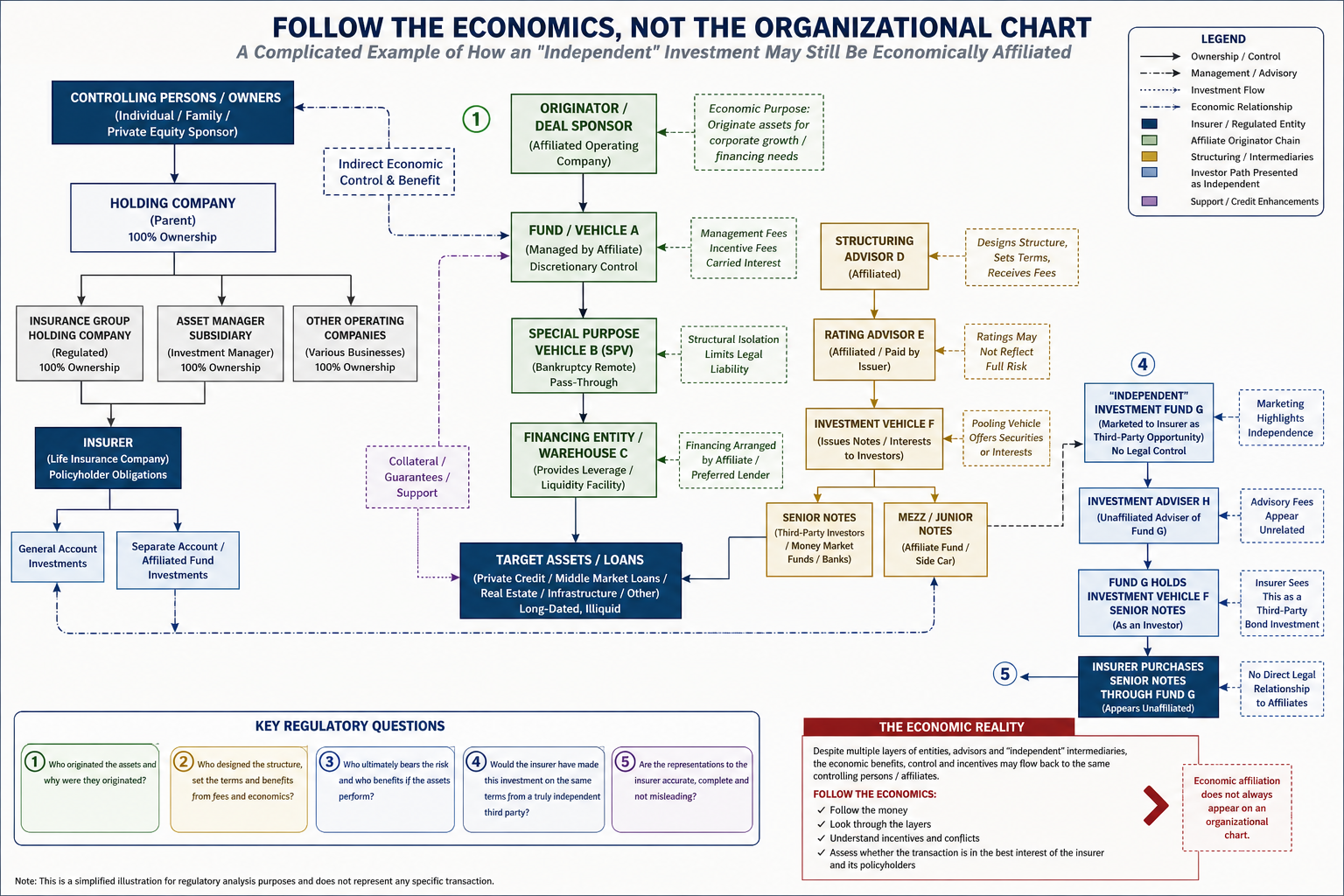
Modern insurance groups can include an insurer, reinsurer, asset manager, private-credit originator, holding company and multiple investment vehicles. They may all be legally distinct while remaining economically connected.
That matters because transactions that look arm’s length on paper can still create concentrated economic exposure when the same organization controls multiple parts of the structure.
Regulators therefore have to look beyond the question, “What security does the insurer own?”
They need to ask who created it, who manages it, who benefits from it, who bears the downside and where the risk ultimately resides.
The organization chart matters.
The economics matter more.
Reinsurance Moves Risk. It Does Not Make Risk Disappear.
Southern Atlantic Re’s inclusion in the rehabilitation petition makes that point even more important.
Reinsurance can be an effective tool for managing risk and capital. But transferring liabilities to another entity does not eliminate the regulator’s obligation to understand what assets support those liabilities and whether the reinsurer can perform when stress arrives.
If the insurer, reinsurer and asset manager are economically interconnected, looking at each entity separately may provide an incomplete picture.
The same principle applies to private-credit structures. Complexity can move risk through different entities and contracts. It does not necessarily eliminate the risk.
The Rating Agency and the Regulator Have Different Jobs
The Atlantic Coast dispute also illustrates the different roles of rating agencies and insurance regulators.
A rating agency provides an independent opinion about financial strength or creditworthiness. A regulator has a statutory obligation to protect policyholders and can take supervisory or legal action.
Those responsibilities overlap, but they are not interchangeable.
A regulator may act before the rating agency does. A rating agency may identify deterioration before the regulator begins formal proceedings. When the two begin moving in the same direction, however, the consequences can become significant.
That is what makes the South Carolina case worth watching.
Private Credit’s Real Regulatory Test
The larger lesson is not that private credit is inherently dangerous.
Private credit has grown because insurers are searching for yield, diversification and assets capable of matching long-duration liabilities. Much of that activity may perform exactly as expected.
But the regulatory system is increasingly being asked to oversee assets that are harder to value, harder to sell and more structurally complicated than conventional publicly traded bonds.
That means regulators cannot rely solely on statutory carrying values or headline credit ratings.
They need to understand the underlying collateral, leverage, liquidity, structural subordination, affiliate relationships, valuation methodology, reinsurance counterparties and likely policyholder behavior under stress.
That requires data.
It requires expertise.
And ultimately, it requires judgment.
The South Carolina case is still being litigated. The regulator has made serious allegations. The companies strongly disagree. The court will determine whether rehabilitation is warranted.
But the larger question is already clear.
Private credit becomes more than an investment issue when uncertainty about asset values begins to affect capital, liquidity, policyholder confidence and the regulator’s ability to determine whether promises to policyholders remain secure.
At that point, the question is no longer:
Is this a good investment?
The question becomes:
Can this insurer still meet its obligations if the investment assumptions are wrong?
I confronted that question as a receiver during the financial crisis.
South Carolina is confronting its version of it now.
And this may be one of the clearest tests yet of how insurance regulation responds when private-credit risk moves from the investment portfolio into the receivership courtroom.