By Sean Dilweg, Former Wisconsin Insurance Commissioner
The artificial intelligence boom is usually discussed as a technology story. Increasingly, it may also be an insurance story.
Building the infrastructure necessary to support artificial intelligence requires extraordinary amounts of capital. Data centers, power generation, transmission, cooling systems, semiconductor capacity and other infrastructure will require hundreds of billions—and potentially trillions—of dollars of investment over the coming years.
Someone has to finance it. Increasingly, some of that capital is coming from private credit. And behind a growing portion of private credit sits a funding source that receives considerably less attention: life insurance and annuity liabilities.
That should have the attention of insurance regulators.
A Fundamental Change in the Life Insurance Model
The relationship between alternative asset managers and life insurers has grown dramatically over the past decade.
Apollo and Athene are perhaps the best-known example, but Blackstone, KKR, Brookfield and other large alternative asset managers have established significant relationships with life insurers through ownership, investment-management agreements, reinsurance arrangements or combinations of the three.
There is a compelling economic logic behind the model.
Annuities provide large amounts of relatively stable, long-duration funding. Alternative asset managers have extensive capabilities originating private credit and structured investments. Bringing those two capabilities together can potentially produce higher investment returns while matching long-duration insurance liabilities.
That does not make the model inherently problematic.
But it does change the risk profile regulators need to understand.
The Federal Reserve Bank of Chicago recently estimated that life insurers held approximately $849 billion of private credit in 2024, representing roughly 14 percent of their assets. Private-equity-affiliated insurers have been important drivers of that growth.
At the same time, private credit is becoming an increasingly important source of financing for AI infrastructure.
Those two trends are beginning to intersect.
Follow the Money
Consider the potential chain:
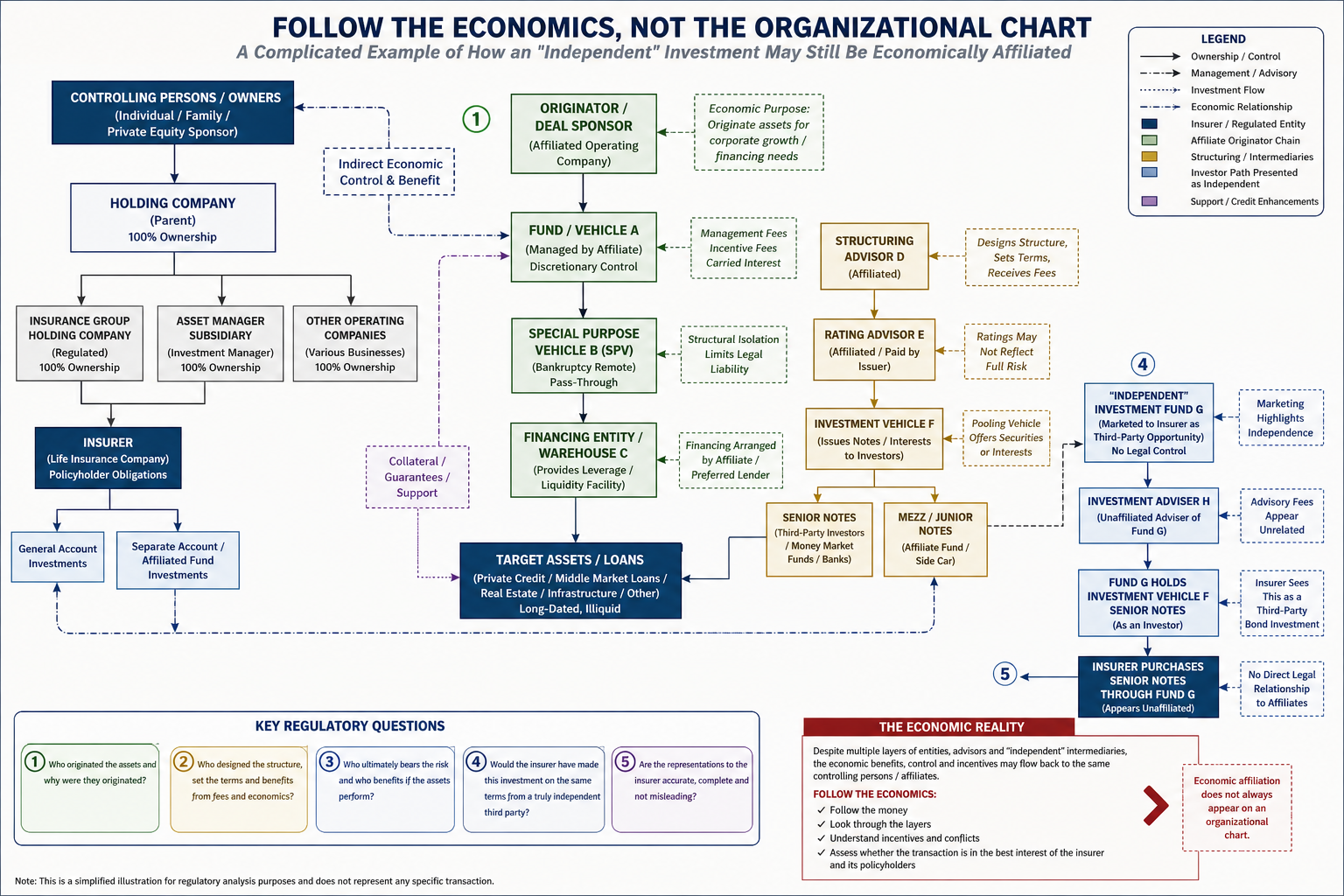
Policyholder buys an annuity → insurer invests the premium → affiliated or third-party asset manager originates private credit → credit finances data centers and AI infrastructure.
There may also be reinsurance arrangements, special-purpose vehicles, securitizations and other structures between those steps.
None of this means the investment is inappropriate.
But from a regulatory perspective, the relevant question is not simply whether an individual security meets an insurer’s investment requirements.
The question is:
Where does the ultimate economic risk reside?
That question becomes particularly important when the same organization may participate at several points in the transaction—as insurer owner, investment manager, asset originator, lender or reinsurer.
The Risk May Be Correlation, Not Credit
AI data centers can be attractive infrastructure investments. Many have sophisticated sponsors, substantial contractual commitments and creditworthy counterparties.
The concern is therefore not that every AI infrastructure investment is speculative.
The more interesting regulatory question is whether investments that appear diversified on an insurer’s balance sheet may ultimately depend upon a relatively small number of common assumptions.
Those assumptions could include continued exponential growth in AI computing demand, availability of inexpensive electricity, sustained utilization of expensive computing equipment, continued access to refinancing markets and the financial strength of a relatively concentrated group of technology companies.
A portfolio might contain dozens of different securities, borrowers and structures.
But if many ultimately depend upon the same economic proposition, the diversification may be less substantial than it appears.
We have seen versions of this problem before. Before the financial crisis, mortgage securities could appear diversified across thousands of borrowers, geographic regions and individual loans. Yet many ultimately depended upon the same underlying assumption: that housing prices would not decline significantly across the country at the same time.
The lesson was not that mortgage-backed securities were inherently bad investments. The lesson was that correlation matters. AI infrastructure deserves the same analytical discipline.
Private Credit Creates Another Challenge: Transparency
Publicly traded bonds provide regulators and markets with observable prices and substantial disclosure.
Private credit is different. The assets frequently do not trade. Valuations may depend upon models. Covenants and collateral packages vary considerably. Some investments are structured specifically for institutional investors.
That does not make private credit unsafe. Insurers have invested in privately placed debt for decades.
But the rapid growth, increasing complexity and greater involvement of affiliated asset managers makes transparency increasingly important.
Regulators need to understand not simply the statutory accounting classification assigned to an investment, but the underlying economic exposure:
- Who originated it?
- Who values it?
- Who manages it?
- What assumptions support that valuation?
- What happens if refinancing becomes unavailable?
- And perhaps most importantly: What other investments on the insurer’s balance sheet depend upon the same underlying assumptions?
This Is Not Yet a Bailout Story
It is important not to overstate the issue.
Some commentary has suggested that losses from private-credit investments would automatically migrate into state insurance guaranty associations and ultimately become a taxpayer bailout.
That misunderstands how insurance regulation works.
Investment losses are first absorbed by the insurer’s earnings, reserves, capital and surplus. State regulators monitor insurer solvency through risk-based capital requirements, financial examinations, investment regulation, holding-company oversight and other tools.
Only an actual insurer insolvency potentially brings the state guaranty association system into play.
Even then, guaranty associations are principally funded through assessments on solvent insurers, subject to state law and coverage limitations. In many states, insurers can subsequently offset portions of those assessments against future premium-tax liabilities, creating some potential indirect public cost.
That is materially different from saying taxpayers have already guaranteed private-credit losses.
But dismissing the concern entirely would be equally shortsighted.
The Regulatory Question Has Changed
Insurance regulation has traditionally focused heavily on the credit quality of individual investments.
The growth of private markets suggests regulators increasingly need to examine something broader: the architecture connecting the investments.
An insurer might separately hold data-center debt, utility infrastructure financing, equipment-backed securities and private loans to technology companies.
Each investment could potentially satisfy applicable regulatory requirements.
Yet all four could ultimately depend upon continued expansion of the same AI ecosystem.
That is a portfolio-level risk that cannot necessarily be identified by examining individual securities in isolation.
Regulators therefore should increasingly ask whether their tools capture economic concentration, not merely issuer concentration.
That means stress testing common assumptions across asset classes, examining affiliated origination and valuation practices, understanding offshore reinsurance exposures and ensuring regulators can trace risk through increasingly complicated investment structures.
The NAIC and state insurance regulators have already begun focusing more heavily on private credit, alternative asset managers, affiliated investments and complex securities.
The AI infrastructure boom makes that work more important.
Follow the Risk
There is nothing inherently alarming about insurance capital financing America’s next generation of infrastructure.
Life insurers have financed American businesses, commercial real estate, utilities and infrastructure for generations. Their long-duration liabilities can make them particularly well suited to long-duration investment.
Private credit can also provide borrowers with capital that traditional banking markets cannot efficiently supply.
And AI infrastructure may ultimately prove extraordinarily productive.
The regulatory challenge is ensuring that financial innovation does not move faster than regulators’ ability to understand where risk has accumulated.
The question therefore should not be whether private equity owns the life insurance industry.
It doesn’t.
Nor should we assume that an AI investment boom inevitably ends with taxpayers absorbing the losses.
There is no basis for that conclusion today.
The more important question is simpler:
As hundreds of billions of dollars move into AI infrastructure, how much of that risk is ultimately migrating onto life insurers’ balance sheets—and can regulators see it clearly enough to understand what happens if the assumptions underlying the AI boom prove wrong?
That is the question worth asking before the cycle turns.